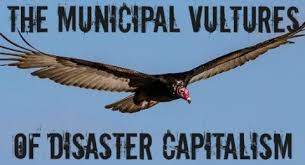
If you live in a city or town served by a paper that’s shrinking, riddled with typos, and hasn’t covered City Hall in six months, you’re not witnessing a slow, natural death. You are witnessing a murder.
The narrative we’ve been sold is simple: The internet killed the newspaper. That’s a profound, self-serving lie. The local news crisis is not solely due to digital disruption; it is the deliberate result of financialization—a calculated strategy by private equity and hedge funds to acquire vital civic institutions, cut them to the bone, and extract every last dime of profit, democracy be damned [https://www.wnycstudios.org/podcasts/otm/segments/journalisms-private-investment-era-on-the-media].
This is the current event nobody sees: Vulture capitalists are systematically dismantling the watchdog that holds local power in check. They are creating news deserts—and those deserts are proving to be the perfect breeding ground for corruption, higher taxes, and a total collapse of community life. Your town is the next victim.
1. The Anatomy of a News Desert: Profit Over Purity 🌵
Over the last 15 years, the infrastructure of local news has crumbled [https://www.pbs.org/newshour/show/growing-local-news-deserts-endanger-democracy-study-finds]. What began as a financial squeeze during the Great Recession has devolved into a deliberate strategy of asset liquidation. Over half of the major daily newspapers in the top 10 chains are now owned or influenced by hedge funds or private equity firms [https://events.temple.edu/graduate-speaker-series-hedged-how-private-investment-funds-helped-destroy-american-newspapers-and].
The model is brutal, elegant, and purely extractive:
- Acquire: Buy newspapers cheaply, often out of bankruptcy, when they’re undervalued.
- Cut Staff: Personnel is the most expensive line item. Lay off reporters and editors by the scores to maximize short-term profits [https://www.wnycstudios.org/podcasts/otm/segments/journalisms-private-investment-era-on-the-media].
- Liquidate Assets: Sell off the paper’s tangible assets: the valuable downtown headquarters, the printing presses, the land. The newspaper becomes a tenant in its own former building.
- Centralize/Syndicate: Shift away from costly original local content—stories about City Council, zoning, and schools—toward cheap, easily syndicated national news [https://www.nber.org/system/files/working_papers/w29743/w29743.pdf].
This leaves one reporter struggling to cover a city of 120,000 people, tasked with monitoring city hall, schools, crime, and business all by themselves [https://www.pbs.org/newshour/show/how-this-vulture-hedge-funds-gutting-of-local-newsrooms-could-hurt-americans]. The paper may technically survive, but the journalism is dead.
2. Who is Buying Your Town’s Voice? Meet Alden Global Capital 🏦
If you need a face for this financial destruction, look no further than Alden Global Capital. Described by critics as a “vulture hedge fund” and a “destroyer of newspapers,” Alden has quickly become the nation’s second-largest newspaper owner by circulation, controlling more than 200 titles, including the Chicago Tribune, The Denver Post, and the New York Daily News [https://files.commons.gc.cuny.edu/wp-content/blogs.dir/8164/files/2022/01/Alden-Global-Capital-the-Hedge-Fund-Killing-Newspapers-The-Atlantic.pdf].
The co-founders of Alden have been brutally open about their disinterest in the long-term health of these papers. Their strategy is simple: operate the papers at a high-profit margin for as long as possible while aggressively cutting costs, indifferent to the subscribers and staff they are alienating [https://indyweek.com/news/longform/sunday-reading-alden-capital/].
Researchers at the University of North Carolina found that Alden-owned newspapers have cut staff at twice the rate of their competitors [https://files.commons.gc.cuny.edu/wp-content/blogs.dir/8164/files/2022/01/Alden-Global-Capital-the-Hedge-Fund-Killing-Newspapers-The-Atlantic.pdf]. They have achieved operating margins up to double that of their peers by leaving newsrooms in a state of crisis and rebellion [https://www.niemanlab.org/2018/05/newsonomics-alden-global-capital-is-making-so-much-money-wrecking-local-journalism-it-might-not-want-to-stop-anytime-soon/].
The profits generated by these papers do not go toward reinvestment. Instead, the money is often used to finance the hedge fund’s other, more lucrative ventures—like real estate or other troubled companies—effectively treating local journalism as a cash cow to be milked until it collapses [https://www.pbs.org/newshour/show/how-this-vulture-hedge-funds-gutting-of-local-newsrooms-could-hurt-americans].
3. The Civic Fallout: Why Your Taxes Just Went Up 📉
The slow, silent death of local journalism isn’t just a business story; it’s a direct threat to your life and local governance.
A growing body of research confirms the terrifying civic consequences of a news desert:
- Increased Corruption: When the watchdog is muzzled, government officials act with impunity. Studies have shown that the disappearance of a major daily newspaper is followed by a significant increase in federal corruption charges (bribery, embezzlement, fraud) in that district [https://www.gmu.edu/news/2024-11/are-us-news-deserts-hothouses-corruption].
- Budget Bloat: With no one holding City Hall accountable, city budgets balloon, leading to higher public costs and increased taxes [https://www.wusf.org/2021-10-18/when-this-hedge-fund-buys-local-newspapers-democracy-suffers].
- Decreased Civic Engagement: When local news declines, citizens have less political knowledge, resulting in lower voter turnout (especially in local elections), increased political polarization, and a general decline in social trust [https://www.hks.harvard.edu/faculty-research/policy-topics/media/local-news-has-long-provided-vital-civic-bond-can-we-afford].
- Misinformation Spreads: The vacuum left by legitimate newspapers is immediately filled by “pink slime websites”—partisan sites disguised as local news that spread misinformation and propaganda [https://www.brennancenter.org/our-work/analysis-opinion/news-deserts-could-impact-midterm-elections].
In short, the cynical, short-sighted greed of hedge funds is exchanging a functional democracy for a short-term, 17% profit margin.
Conclusion: How to Fight Back ✊
The good news is that this isn’t an inevitable fate. The organized resistance by journalists is working. For example, journalists at the Alden-owned Southern California News Group recently voted to ratify a contract after a threatened strike, securing significant pay raises and essential protections against layoffs and the arbitrary use of AI [https://newsguild.org/california-journalists-vote-to-approve-contract-with-alden-global-capital/].
This shows that labor organizing can force vulture capitalists to invest, or at least divest, in a moral way.
If you care about local governance, fighting corruption, and having a source of truth for your community, your task is simple and immediate:
- Stop rewarding the Vultures. Do not subscribe to hedge fund-owned papers that strip-mine their newsrooms.
- Support Non-Profit Journalism. Find and fund the local non-profit digital newsrooms, investigative outlets, and university-affiliated projects that are springing up to fill the void.
- Unionize the News. Support the efforts of journalists to organize and collectively bargain for the resources and staffing required to do their civic job.
We must radically shift how we view journalism: it is not a commercial product; it is public infrastructure [https://www.pbs.org/newshour/show/growing-local-news-deserts-endanger-democracy-study-finds]. If we don’t start defending this infrastructure now, we will wake up one day to find that the lights have gone out on local accountability entirely.
