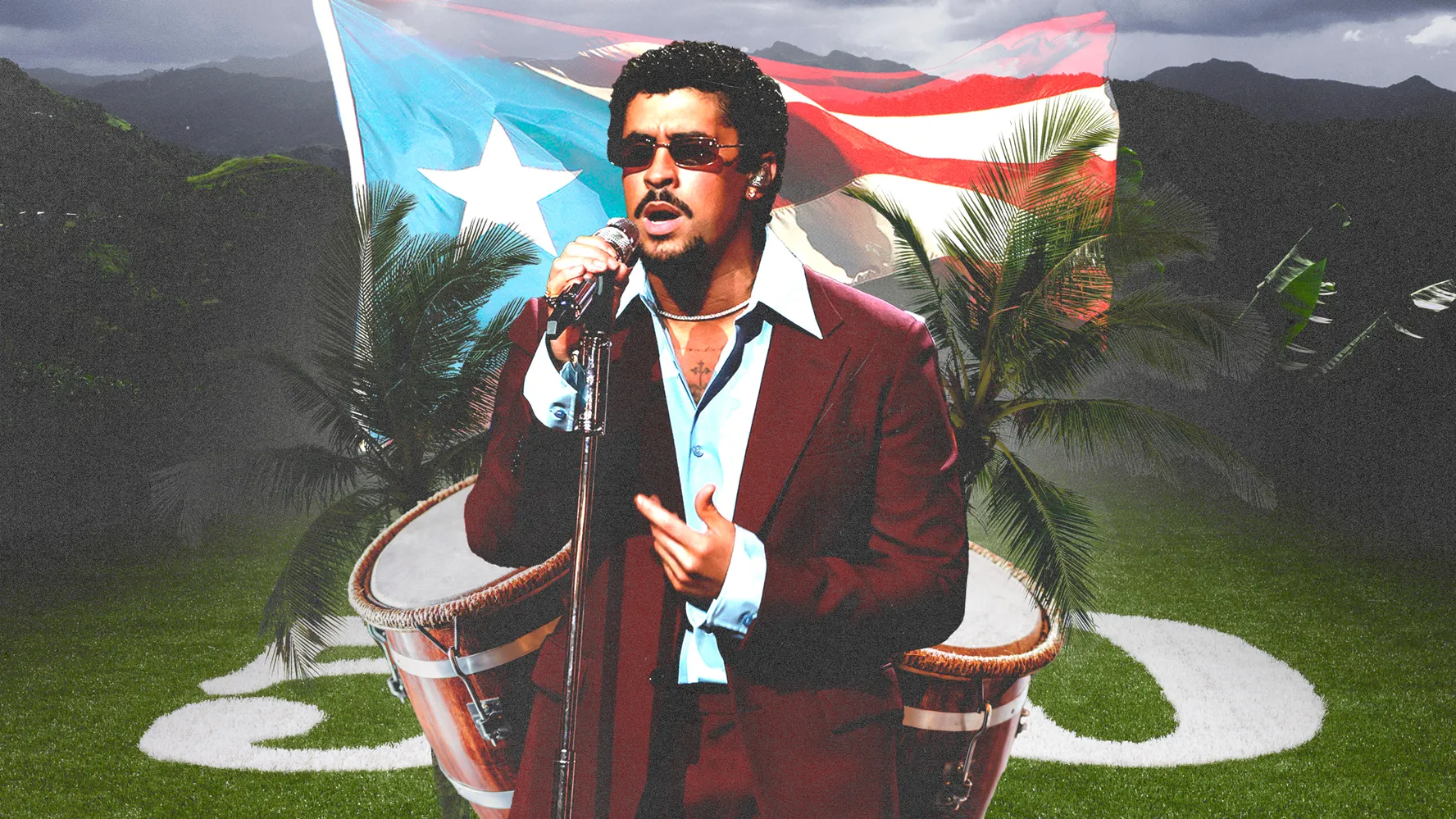
When Bad Bunny walked off the stage after headlining the Super Bowl LX Halftime Show, he didn’t just leave behind a performance—he left behind a storm.
Within hours, one of the most recognizable artists in the world had wiped his Instagram clean. No posts. No following list. No explanation. Just a blank page where millions of fans once scrolled daily. In a digital world that thrives on constant visibility, that kind of disappearance doesn’t feel accidental—it feels like a message.
The timing made it impossible to ignore. His halftime show had already divided audiences in real time, sparking praise, criticism, confusion, and cultural debate across nearly every major social platform. And just as the internet reached peak discussion, he vanished from one of its most influential stages.
That’s when the real conversation began.
The performance itself was never going to be neutral. As the first solo Latino artist to headline the Super Bowl halftime show, Bad Bunny stepped into a space that carries enormous cultural weight. The Super Bowl isn’t just a sporting event—it’s one of the most-watched broadcasts in the world, a stage where symbolism, identity, and entertainment collide in front of a massive global audience.
He chose to perform largely in Spanish, weaving together music, visuals, and themes rooted in Latin identity and culture. For millions of fans, especially across Latin America and the U.S. Latino community, it was a powerful moment of representation—one that felt long overdue. It wasn’t just about music; it was about visibility on the biggest possible platform.
But the same elements that made the performance meaningful to some made it controversial to others.
Critics argued that the show felt inaccessible or overly political. Some questioned whether a predominantly Spanish-language performance belonged at such a broadly American event. Others focused on specific artistic choices, interpreting them through their own cultural or political lenses. As always, the internet accelerated everything. Clips circulated within minutes. Opinions hardened within hours.
What might have once been a week-long media cycle became an immediate digital clash.
And then, just as people expected some kind of response—a clarification, a statement, a defense—there was nothing.
Instead, there was absence.
That absence turned into its own kind of statement. In today’s internet culture, silence rarely reads as neutrality. When someone as visible as Bad Bunny deletes their content right after a controversial moment, people don’t assume coincidence. They assume intention. Theories spread quickly: maybe it was a reaction to backlash, maybe it was emotional, maybe it was calculated, maybe it was the beginning of a new artistic era.
The truth is, without an explanation, all of those interpretations can exist at once. And that ambiguity is exactly what fuels engagement.
Fans immediately split into camps. One side defended him, framing the performance as groundbreaking and the disappearance as either a deserved break or a brilliant artistic move. They pointed out that Bad Bunny has always pushed boundaries—musically, culturally, and politically—and that expecting him to conform to mainstream expectations misses the point of his work entirely.
On the other side, critics saw the Instagram wipe as avoidance. To them, it looked like stepping away instead of standing behind a controversial performance. In a media environment where public figures are often expected to respond instantly to criticism, silence can feel like evasion.
But there’s a third perspective that might be the most compelling: that this wasn’t reactionary at all—it was strategic.
In the modern entertainment landscape, attention is everything. Artists no longer compete just on charts or streams; they compete in the constant flow of online conversation. Staying relevant means staying visible, and staying visible usually means posting more, engaging more, explaining more.
Bad Bunny did the opposite.
By disappearing, he extended the life of the moment. Instead of the conversation fading after the performance, it evolved. The focus shifted from “Was the show good or bad?” to “Why did he disappear?” That second question is far more open-ended, and far more sustainable. It invites speculation, analysis, and ongoing discussion.
It also puts him in control.
When an artist speaks immediately after a controversy, they often shape the narrative—but they also limit it. They close certain interpretations while opening others. By refusing to explain, Bad Bunny keeps the narrative fluid. He allows different audiences to project their own meanings onto his actions.
And in doing so, he maintains relevance without constant output.
What makes this even more interesting is how it contrasts with typical influencer behavior. Social media has trained audiences to expect consistency. Daily posts, behind-the-scenes content, direct engagement—these are the norms that drive algorithms and maintain visibility. Disappearing breaks that pattern.
It creates scarcity.
Scarcity, in turn, creates value. When something isn’t always available, it becomes more desirable. Every potential return becomes an event. Every post becomes meaningful. Fans pay closer attention because they don’t know when—or if—they’ll get another glimpse.
Bad Bunny’s brief return to Instagram only reinforced this idea. When he posted a single image for his birthday and then deleted it within 24 hours, it felt less like a casual update and more like a controlled moment. It suggested a new kind of relationship with his audience—one based not on constant access, but on selective presence.
This approach taps into a broader shift in how audiences interact with celebrity culture. There’s growing fatigue with the endless stream of content. The illusion of constant accessibility has started to feel repetitive, even exhausting. In that context, mystery becomes refreshing.
Bad Bunny’s silence stands out because it breaks the rhythm.
It also reflects a deeper tension in modern fame: the balance between accessibility and control. Social media has given celebrities unprecedented direct access to their audiences, but it has also created pressure to be constantly available, constantly responsive, constantly visible.
By stepping away—even temporarily—Bad Bunny reclaims some of that control.
Of course, none of this erases the cultural conversation sparked by the performance itself. The debates about language, representation, and identity are still ongoing. In many ways, the Instagram disappearance has amplified those discussions rather than replacing them.
It has turned a single performance into a multi-layered cultural moment.
People aren’t just talking about what happened on stage—they’re talking about what happened afterward, and what it means. They’re debating not just the art, but the reaction to the art, and the reaction to the reaction.
That’s the nature of internet culture today. It’s recursive. Every moment creates another moment. Every action creates another layer of interpretation.
And in that environment, silence can be just as powerful as expression.
There’s also something uniquely fitting about this situation given Bad Bunny’s career. He has consistently challenged expectations—whether through his music, his fashion, or his public statements. He has blurred lines between genres, languages, and identities. He has built a global audience while staying rooted in his cultural identity.
Disappearing from Instagram doesn’t contradict that pattern. If anything, it extends it.
It challenges the expectation that artists must always explain themselves. It resists the idea that visibility equals relevance. It suggests that control over one’s narrative can come not just from speaking, but from choosing not to.
Whether intentional or not, the result is the same: people are still talking.
And that may be the most important metric of all.
In a media landscape where attention shifts constantly and quickly, sustaining conversation is incredibly difficult. Most viral moments fade within days. Most controversies are replaced by the next one. But this moment—fueled by both a divisive performance and a deliberate absence—has lasted.
It has evolved.
It has expanded.
And it continues to generate new interpretations.
As of now, there’s still no official explanation from Bad Bunny. No statement clarifying his intentions. No confirmation of whether the Instagram wipe was strategic, emotional, or something else entirely.
But maybe that’s exactly why it matters.
Because in a world where everything is explained, analyzed, and dissected almost instantly, leaving something unresolved creates space. Space for debate. Space for interpretation. Space for ongoing attention.
Bad Bunny didn’t just perform at the Super Bowl.
He created a moment that extended far beyond it.
And by saying nothing afterward, he ensured that the conversation wouldn’t end when the music did.